The 2026 FIFA World Cup is the largest in history: 48 teams, 11 U.S. host cities, and hundreds of elite international athletes competing on American soil. For many of them, the tournament is also an inflection point. Sponsorships, league contracts, media opportunities, and business ventures make a long-term U.S. presence genuinely valuable for the first time.
Which raises a question more athletes, and the agents, clubs, and managers who represent them, are starting to ask: what’s the right visa for a professional athlete who wants to live and work in the U.S. long term?
The answer, more often than people expect, is the O-1A.
What is the O-1A visa?
The O-1A is a nonimmigrant work visa for individuals with extraordinary ability in the sciences, education, business, or athletics. It has no annual cap, no lottery, and no degree requirement. It is granted for up to three years initially, with unlimited one-year extensions as long as qualifying work continues.
For professional athletes, it offers a level of flexibility and long-term optionality that most other visa categories simply don’t.
Why athletes should know about the O-1A
Most athletes entering the U.S. to compete do so on a P-1A visa, which is designed for internationally recognized athletes. The P-1A is common, well understood, and widely used by professional sports organizations. But it’s not always the best fit.
The O-1A is tied to you, not your team. A P-1A typically requires sponsorship from a specific organization. If you change teams, retire from active competition, or want to pursue other activities in the U.S., coaching, consulting, media work, business ventures, the P-1A may not cover you. The O-1A follows the individual.
The O-1A is more portable across activities. Because it’s based on your extraordinary ability rather than a specific athletic engagement, it can cover a broader range of work: training, endorsement appearances, speaking engagements, and business activities related to your sport.
There’s no cap and no lottery. If you qualify and your petition is properly documented, you can be approved, without competing against thousands of other applicants for a limited pool of visas.
The O-1A can be a stepping stone to permanent residence. Athletes who qualify for an O-1A are often strong candidates for the EB-1A green card. The evidentiary standards overlap significantly, and building a strong O-1A case now can lay the foundation for a green card petition later.
Who qualifies for an O-1A as an athlete?
USCIS requires that O-1A petitioners demonstrate extraordinary ability, defined as a level of expertise indicating that the person is one of the small percentage of individuals who have risen to the very top of their field.
That’s a high bar, but it doesn’t mean you need to be the world’s best. It means you need to document, with evidence, that you operate at an elite level within your sport.
To establish this, USCIS looks for either:
- A major internationally recognized award (an Olympic medal, a World Championship title), or
- Evidence meeting at least three of the following eight criteria.
The eight O-1A criteria for athletes:
- 1Critical or leading role in a distinguished organization or event
- 2High salary or remuneration relative to others in the field
- 3Judging the work of others in the field (selection panels, scouting committees, coaching at elite levels)
- 4Original contributions of major significance in the field
- 5Scholarly articles authored about the sport or athletic performance
- 6Published material about the petitioner in professional or major trade publications or media
- 7Membership in associations that require outstanding achievement, as judged by recognized experts
- 8Awards or prizes for excellence in the field from recognized judges, panels, or bodies
In practice, for athletes, the most commonly documented criteria are critical or leading role, high salary, awards or prizes, and published media coverage. Many elite athletes can check three or more of these without realizing it.
What evidence supports an O-1A petition for athletes?
The O-1A is evidence-heavy. The strength of the petition depends almost entirely on what you can document and how it’s framed.
Strong evidence for athlete O-1A petitions typically includes:
- Contracts, pay stubs, or financial records showing compensation relative to peers in the sport
- Records of participation in high-profile competitions, leagues, or tournaments (World Cup, Olympics, Champions League, major domestic leagues)
- Media coverage, articles, broadcasts, profiles, from recognized sports outlets naming the athlete specifically
- Award documentation: trophies, rankings, selection to national teams, MVP designations, all-star selections
- Evidence of invitations to serve as a judge, selector, scout, or coach in official capacities
- Expert opinion letters from credible figures in the sport, coaches, federation officials, sports journalists, fellow athletes with standing, attesting to the petitioner's level of achievement
- Statistical evidence: performance rankings, league standings, records, comparisons to peers
A note on expert letters. These matter more than most athletes expect. USCIS wants to hear from recognized authorities in the field, not character witnesses. A letter from a former national team coach, a federation director, or a widely respected figure in the sport carries significant weight. Letters need to be specific, detailed, and written by individuals whose credentials will carry genuine weight with USCIS. Generic letters of praise, even from well-known people, don’t move the needle.
The O-1A process: how it works
You need a U.S. petitioner. The O-1A requires a U.S. petitioner to file on your behalf. This can be a sports club, franchise, or organization; an agent or management company; or an individual employer hiring you to coach, consult, or perform in a sport-related capacity. The O-1A does not allow self-petitioning.
The O-1A does not have to be tied to a single team or employer. If your petitioner is an agent or your own management entity, the visa can cover multiple engagements: competitions, endorsements, appearances, coaching. That’s significantly more flexibility than a team-specific petition.
Peer consultation is required. USCIS requires that an O-1A petition include a written advisory opinion from a peer group, labor organization, or management organization in the relevant field. For athletes, this typically means a relevant athletic association or union. This step needs to be part of the process from the start, not an afterthought. It has real timeline implications.
Filing and processing. Your petitioner files Form I-129 along with all supporting documentation. Standard processing currently runs several months. Premium processing, which guarantees a response within 15 business days, is available and commonly used when timing matters, for example when a competition season is approaching.
If you’re outside the U.S. Approval of the I-129 petition is the first step. You’ll also need to complete consular processing: filing Form DS-160, scheduling a visa interview at a U.S. consulate, and obtaining the O-1 visa stamp before entering the U.S. to begin work.
If you’re already in the U.S. If you’re in the U.S. on another valid visa, your petitioner can file for a change of status to O-1A at the same time as the I-129. You can begin O-1A work once USCIS approves the change of status, not before.
Duration and extensions. Initial O-1A visas are granted for up to three years, with unlimited one-year extensions as long as you continue working in the field.
What happens if you’re traded or change teams?
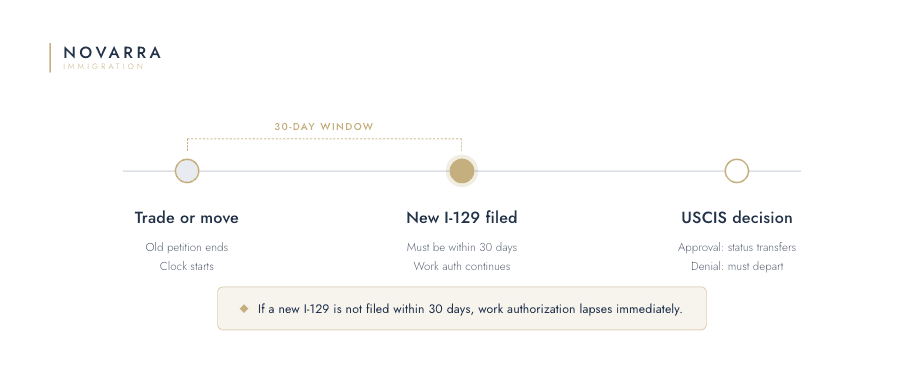
If you move to a new team, the new employer needs to file a new Form I-129 on your behalf. You may continue working for the new team for up to 30 days while the new petition is being prepared. Once the new I-129 is filed within that 30-day window, your work authorization remains valid while USCIS processes it.
If the new petition is not filed within 30 days, or if USCIS denies it, you lose employment authorization and may need to depart the U.S.
This is one reason athletes and their representatives should understand the mechanics of the O-1A before a career move, not after.
Bringing your family and support staff
Family members: the O-3 visa. Your spouse and children under age 21 can join you in the U.S. on O-3 dependent visas. They can live and study in the U.S. but cannot work. If your spouse wants to work, they’ll need to qualify for their own visa.
Essential support staff: the O-2 visa. Coaches, trainers, physiotherapists, sports psychologists, and similar personnel who are integral to your performance may be eligible to accompany you on O-2 visas. Each support staff member needs their own petition, and that petition must include evidence that their work is essential to your performance and that their skills are specialized, not easily replaceable by a U.S. worker. O-2 status is tied to the O-1A athlete; if your status ends, theirs ends as well.
Traveling while on O-1A status
O-1A holders can travel internationally, but you need the right documentation every time you re-enter the U.S.:
- A valid O-1 visa stamp in your passport
- Your valid passport
- Form I-797 approval notice
If your O-1 visa stamp expires while you’re in the U.S., you can remain and work as long as your I-797 approval covers you, but you’ll need a new visa stamp before re-entering after any international travel.
The O-1A vs. the P-1A
Both visa categories are used by professional athletes in the U.S. Here’s how they compare:
| O-1A | P-1A | |
|---|---|---|
| Who it's for | Extraordinary ability in athletics | Internationally recognized athletes |
| Who files | Team, agent, or management entity | Typically a team, league, or sponsoring org |
| Portability | Can cover multiple engagements if agent-sponsored | Often tied to a specific engagement |
| Standard | Extraordinary ability (top of field) | International recognition |
| Duration | Up to 3 years; unlimited 1-year extensions | Up to 5 years; extensions available |
| Support staff | O-2 visas available | O-2 visas available |
| Family | O-3 visas for spouse and children under 21 | O-3 visas for spouse and children under 21 |
| Green card pathway | Strong bridge to EB-1A | Less directly aligned |
| Annual cap | None | None |
For athletes who are mid-career and want flexibility, or who are thinking seriously about long-term U.S. residency, the O-1A often makes more strategic sense, even if it requires more work to document.
The O-1A as a bridge to a green card
The EB-1A is an employment-based green card for individuals with extraordinary ability. Its evidentiary framework, ten criteria under 8 C.F.R. § 204.5(h)(3), analogous to but not identical with the O-1A’s eight, shares significant overlap with the O-1A standard. Athletes who have successfully obtained an O-1A, and who have continued to build their record during that period, are often well-positioned to file an EB-1A petition.
The EB-1A also allows self-petitioning, meaning you don’t need an employer to sponsor your green card. That’s a significant benefit for athletes whose career trajectories don’t fit neatly into traditional employment structures.
Building an O-1A case strategically, with an eye toward eventual EB-1A eligibility, is something a good immigration attorney should help you think through from the start.
Common mistakes athletes make with O-1A petitions
Underestimating their own qualifications. Many elite athletes assume they don’t qualify because they haven’t won a world title. The three-criteria standard exists precisely for athletes who are exceptional but not singularly dominant. If you’ve played at the highest professional level, earned a competitive salary, and received meaningful media coverage, you may be a stronger candidate than you think.
Relying too heavily on one type of evidence. A petition that documents only one criterion in depth but checks the box weakly on two others is vulnerable. Strong petitions present each criterion with depth and specificity.
Treating expert letters as an afterthought. Letters from coaches, federation officials, and respected figures in the sport are often the difference between a strong petition and an RFE. They need to be solicited early, drafted carefully, and written by individuals whose credentials will carry genuine weight with USCIS.
Not accounting for the peer consultation requirement. Forgetting this step, or completing it incorrectly, can delay a petition significantly. It needs to be built into the timeline from the start.
Assuming the petition transfers automatically when you change teams. It doesn’t. A new I-129 needs to be filed within 30 days of the move. Agents and athletes who don’t know this find out the hard way.
Filing without premium processing when timing matters. Competition seasons don’t wait for USCIS. If your timeline is sensitive, premium processing is usually worth it.
How Novarra approaches athlete O-1A cases
At Novarra, we work with exceptional individuals, including athletes and the teams and agents who represent them, on O-1A and EB-1A petitions. We’re direct about whether a case is ready to file, and we don’t take on cases we don’t believe in.
If you’re evaluating O-1A eligibility for yourself or someone you represent, we’re happy to have an honest conversation about where things stand and what it would take to build a strong petition.