
The O-1B is the visa the immigration system accidentally got right for creative professionals. No annual cap, no lottery, no degree requirement, and built around a standard, extraordinary achievement, that actually maps onto how artistic careers develop.
It is also one of the most misunderstood visa categories in practice. The evidentiary standard is genuine, the advisory opinion process is more complex than most guides acknowledge, and the distinction between the arts and motion picture/television subcategories has real consequences for how a petition is built. This guide covers what the O-1B actually requires, what it looks like across different creative fields, where petitions go wrong, and how to position it as the first chapter of a longer immigration story.
What is the O-1B visa?
The O-1B is a nonimmigrant work visa for individuals with extraordinary achievement in the arts, or extraordinary achievement in the motion picture and television industry. It is one of two subcategories of the O-1 visa:
- O-1A: extraordinary ability in science, education, business, or athletics
- O-1B: extraordinary achievement in the arts, motion picture, or television
The O-1B is granted for up to three years initially, with unlimited one-year extensions as long as qualifying work continues. For creative professionals whose careers don’t fit the H-1B’s specialty occupation framework, it’s often the only viable long-term work visa option.
Arts vs. motion picture and television: a distinction that matters
The O-1B covers two subcategories with different evidentiary frameworks, and getting the categorization right shapes everything about how the petition is built.
Arts covers performers, visual artists, musicians, dancers, choreographers, models, writers, composers, and similar creative professionals whose work falls outside film and television production.
Motion picture and television covers directors, producers, cinematographers, editors, actors, and other professionals working specifically in film and TV production. USCIS applies the extraordinary achievement standard with reference to the specific competitive environment of that industry.
An actor who has appeared in television productions may fall under the motion picture/television standard. A visual artist whose work has appeared in galleries and publications falls under the arts standard. A musician who performs in concert but has also appeared on television needs to think carefully about which subcategory to invoke, and why.
The two paths to eligibility
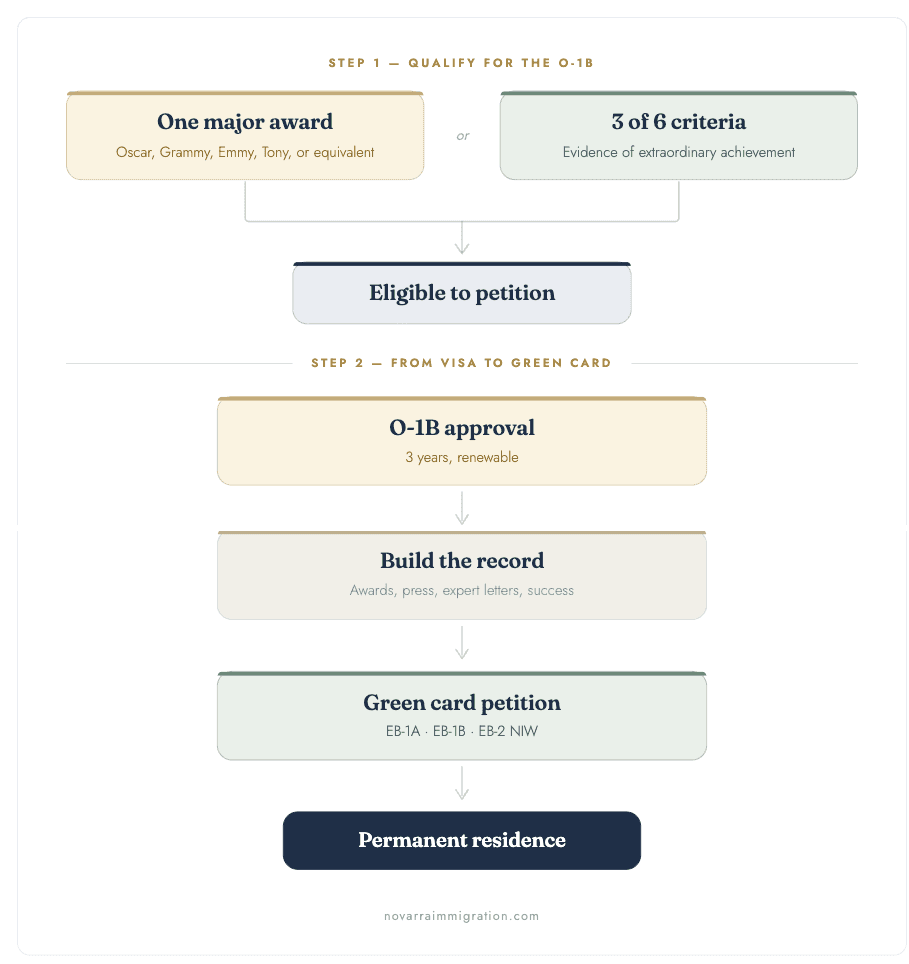
Path 1: a major internationally recognized award. A prize or award recognized as a mark of distinction in your field, an Oscar, Grammy, Emmy, Tony, Pulitzer, Booker Prize, or equivalent, can establish eligibility on its own. USCIS looks for awards with genuine international recognition, not regional or industry-internal honors.
Path 2: evidence meeting at least three of six criteria. For most working creative professionals, eligibility is established by meeting at least three of the following:
- 1Lead or starring role in distinguished productions or events. Evidence of your role and the distinction of the production: critical reviews, press coverage, contracts, advertisements. The production's reputation matters as much as the role itself.
- 2National or international recognition for achievements. Published material in major media, newspapers, trade journals, magazines, specifically about you and your achievements. Passing mentions don't qualify; substantive coverage does.
- 3Lead, starring, or critical role in organizations with distinguished reputations. Your role within a major record label, prominent production company, distinguished theater or dance company. The organization's reputation is part of the criterion.
- 4Record of major commercial or critically acclaimed successes. Box office receipts, streaming numbers, album sales, awards, ratings: measurable commercial or critical success documented with trade publication coverage.
- 5Significant recognition from organizations, critics, government agencies, or recognized experts. Substantive assessments from recognized authorities in your field. The letter writers' own standing matters as much as what they say.
- 6High salary or remuneration relative to others in the field. Compensation significantly above comparable positions, documented with contracts and supported by industry compensation data.
What extraordinary achievement looks like by field
Musicians and recording artists. Strong evidence includes recording contracts with recognized labels, tour contracts with well-regarded venues, critical reviews in music press, streaming numbers with contextual benchmarks, awards or nominations from recognized industry bodies, and performance at prestigious festivals. What USCIS struggles with: streaming numbers alone, social media following without industry recognition, self-released recordings without critical or commercial documentation. The evidence needs to connect your work to recognized industry structures.
Visual artists. Strong evidence includes exhibitions at recognized galleries or institutions, catalog essays by established curators or critics, acquisition by public collections or notable private collectors, critical reviews in art press, auction records, and commissions by distinguished organizations. The visual art world operates through institutions: galleries, museums, curators, critics. Evidence needs to speak through those channels.
Actors and performers (theater, dance, film, television). Strong evidence includes lead or starring roles in productions with documented critical recognition, reviews in recognized trade publications, awards from recognized industry bodies, and testimonials from recognized directors, choreographers, or producers. Actors working specifically in film and television should evaluate whether the motion picture/television subcategory applies. The evidence framing should reflect that industry’s competitive context.
Directors and filmmakers. Strong evidence includes festival selections at recognized festivals (Sundance, TIFF, Cannes, Berlin, Tribeca, and similar), distribution deals, critical reviews, box office or streaming performance data, and awards or nominations from recognized film bodies. A feature that premiered at a major festival and received substantive critical coverage tells a more compelling story than one with favorable self-reports and no external validation.
Dancers and choreographers. Strong evidence includes principal or soloist roles with distinguished companies, reviews in recognized dance press, choreographic commissions from recognized companies or institutions, performance at prestigious venues, and testimonials from established figures in the dance world: artistic directors, senior choreographers, recognized critics.
Digital creators and content professionals. Digital creators can qualify for an O-1B, but the path requires careful construction. Social media metrics alone are not sufficient evidence. What matters is whether your digital creative work has achieved recognition connecting to recognized industry structures: press coverage in established outlets, collaborations with entities of documented standing, inclusion in industry recognition programs, commercial success with documented metrics. This is one of the more complex O-1B evidence situations, and one where experienced counsel makes the most difference.
The advisory opinion: more complex than most guides acknowledge
All O-1 petitions require a written advisory opinion from an appropriate peer group, labor organization, or recognized expert. For O-1B applicants, this step deserves more attention than it typically gets.
For motion picture and television: relevant organizations include SAG-AFTRA for actors, DGA for directors, and IATSE for production technicians. These organizations take the advisory opinion process seriously and have their own procedures and timelines.
For performing arts: AGMA covers opera, dance, and concert performers. AFM covers musicians. Equity covers stage actors.
For visual arts and fields without a clear union: the advisory opinion may come from a management organization or a panel of recognized experts. This is more flexible but requires deliberate thought about who the recognized authorities are and how to document their standing.
The most common mistake here is treating the advisory opinion as a formality and discovering the relevant union has a six-week review process after a filing date is already committed. Build this into the timeline from the beginning. A favorable opinion from a recognized organization carries real weight with USCIS. An unfavorable one is not automatically fatal but needs to be addressed directly and strategically, not defensively.
Common mistakes that sink O-1B petitions
Conflating reputation with documented achievement. Being well-known within a scene is not the same as having documented evidence USCIS can evaluate. The criteria need to be satisfied with specific, verifiable documentation.
Weak or generic expert letters. Letters from peers or colleagues without established authority add little. Letter writers need to be recognized authorities whose own standing in the field is documented. A letter from the artistic director of a major company or the head of a recognized gallery carries weight. A letter from a fellow artist does not.
Filing before the record is ready. The O-1B standard is genuine. A petition with one strong criterion and two marginal ones produces an RFE or denial, creates a record, and costs more to resolve than waiting would have. A few months of deliberate work, a critical review, a salary benchmark, a testimonial from a recognized authority, can make the difference.
Not thinking about the long game. The O-1B is the beginning of an immigration story. Filing without any thought about permanent residence pathways means making decisions now that may constrain options later.
The O-1B and permanent residence
The O-1B does not automatically lead to a green card, but for creative professionals with the right record, permanent residence is more accessible than most people realize.
EB-1A: extraordinary ability is the most directly relevant pathway for O-1B holders. It operates on a ten-criteria framework (analogous to, but not identical with, the O-1B’s six criteria) and allows self-petitioning, with no employer sponsorship required. The standard is higher, and the evidence needs to be stronger. An O-1B approval is meaningful context but does not guarantee EB-1A approval. Creative professionals who continue building their record during the O-1B period, additional critical recognition, awards, commercial success, press coverage, are better positioned for the EB-1A than they were at the time of the O-1B filing.
EB-1B: outstanding professor or researcher may be relevant for creative professionals working in academic contexts: teaching at recognized universities, conducting research in the performing arts. It requires employer sponsorship.
EB-2 NIW: national interest waiver is worth evaluating for creative professionals whose work has broader cultural or social significance: composers, filmmakers, writers whose work is recognized as contributing to national cultural life. It’s not appropriate for most O-1B holders but merits consideration in the right circumstances.
The evidence you build during the O-1B period matters for your eventual green card petition. This is not incidental. It’s strategic. A filmmaker who uses the O-1B period to secure another festival selection, a substantive critical review, and an awards nomination is building toward the EB-1A. One who simply maintains status without thinking about what comes next may find themselves starting from scratch when they’re ready to pursue permanent residence.
The application process
Step 1: honest assessment of your evidentiary record. Map your record against the six criteria before engaging an attorney. Be specific about where you have documentation and where you don’t. If two criteria are strong and the third is marginal, the petition may need more development before filing.
Step 2: identify your petitioner. You cannot self-petition for an O-1B. For creative professionals who work across multiple engagements, the agent model is often more appropriate than an employer-specific petition. A U.S. agent can cover multiple performances, recordings, exhibitions, and projects under a single petition.
Step 3: obtain the advisory opinion. Initiate the peer consultation process early. Identify the appropriate union or peer organization, understand their process and timeline, and build that into your filing schedule.
Step 4: build the petition. The cover letter is the most important document. It frames your creative work, your achievements, and your evidence for an adjudicator who may have no familiarity with your field. The quality of that framing is what separates strong petitions from marginal ones.
Step 5: file, with timing in mind. Standard processing runs several months. Premium processing guarantees a response within 15 business days and is worth the cost when timing is sensitive.
Step 6: change of status or consular processing. If you’re in the U.S. in valid nonimmigrant status, the petition can include a change of status request. If you’re abroad, you’ll complete consular processing at a U.S. embassy or consulate.
Government filing fees
Fees as of mid-2026. Verify current amounts at uscis.gov before filing.
| Fee | Amount |
|---|---|
| Form I-129, standard employer | $1,055 |
| Form I-129, small employer or nonprofit | $530 |
| Asylum Program Fee, standard employer (25+ FTE) | $600 |
| Asylum Program Fee, small employer (25 or fewer FTE) | $300 |
| Asylum Program Fee, nonprofit | $0 |
| Premium processing (optional, 15-business-day guarantee) | $2,965 |
How Novarra approaches O-1B cases
Creative careers don’t follow the same patterns as technology or academic careers, and O-1B petitions that treat them as if they do consistently underperform. At Novarra, we approach O-1B cases with field-specific evidence strategy, genuine knowledge of the relevant unions and advisory opinion processes, and an understanding that framing a creative professional’s work for a USCIS adjudicator requires both legal expertise and substantive knowledge of the creative industries.
We also approach every O-1B case with legacy planning in view. The O-1B you file today should be built with the EB-1A you may file in three to five years already in mind. The evidence you gather, the expert letters you develop, the documentation you maintain during the O-1B period: all of it either builds toward or detracts from the green card case. At Novarra, those two timelines are part of the same conversation from the beginning.
If you’re a creative professional evaluating your O-1B options, or an agent or manager representing creative talent, we’re happy to start with an honest assessment of where your evidentiary record stands and what it would take to build a compelling petition. The Profile Building Session is where that conversation begins, and $1,000 of the $1,500 fee applies toward full petition work if you move forward.